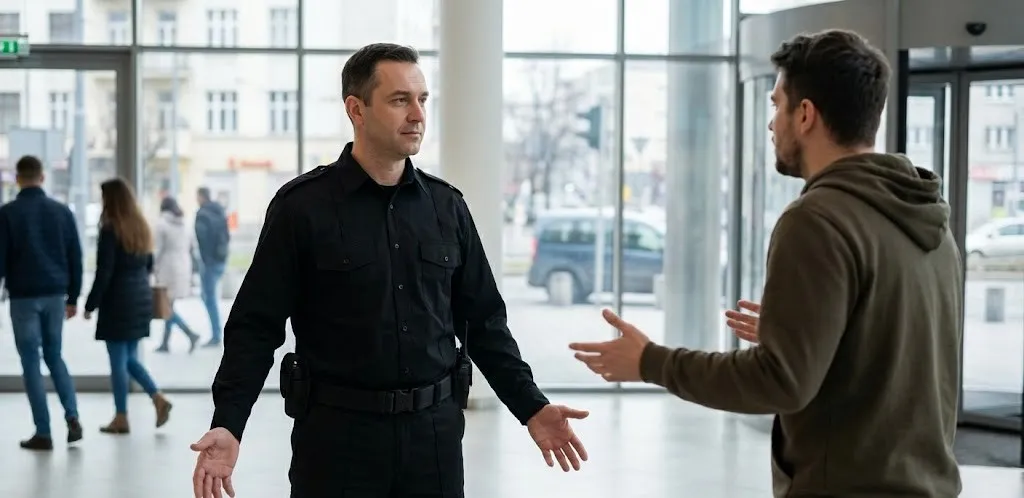
Problems at an event or site often begin before any physical intervention is needed. Early recognition of changing behaviour, calm communication and controlled responses can prevent unnecessary escalation.
De-escalation does not mean weakness or abandoning the rules. It protects visitors, staff, clients and security officers. Good communication can resolve a situation before it becomes dangerous, legally complex or damaging to reputations.
What de-escalation means in practice
De-escalation is a conscious reduction of tension. A security guard is not trying to win an argument. They are trying to return the situation to a mode that is safe, understandable and controllable. This requires a calm voice, clear boundaries, the ability to listen and an agreed procedure in the team.
- Calmness: the worker speaks matter-of-factly and does not take on the emotions of the other party.
- Clarity: a person must know what is wanted of him and why.
- Respect: decent communication reduces the need for the other party to defend their face in front of others.
- Boundaries: rules must be stated firmly but without humiliation.
- Continuity: the team must know when to hand over the situation to the manager, organizer, paramedics or the police.
Why conflicts escalate
Conflict usually does not arise from one sentence. It often consists of fatigue, alcohol, frustration from waiting, a sense of injustice, bad information or trying not to lose face in front of friends. On the security team's side, the problem can be exacerbated by inconsistent communication, an unnecessarily harsh tone, or an unclear reason for the intervention.
The first step is therefore to understand what is actually happening. A person who shouts at the entrance is not automatically aggressive. He may be confused, tired, under the influence of alcohol, having a ticket problem or trying to reach someone in the group. The approach depends on the situation, not on the first impression.
Security Officer Role
The security team is there to protect people, safe operations and the venue’s rules. Its actions should be clear to everyone nearby. Visitors notice the officer’s tone, stance and treatment of the person involved as well as the words used.
It is important to separate the person from the behavior. The sentence "this behavior cannot continue here" works better than a personal label. It also helps to talk about a specific rule rather than a worker's personal opinion.
How to start a conversation
The first sentence often sets the whole course. It should be short, polite and specific. It is appropriate to use a neutral address, describe the observed behavior and say what needs to be done next.
"Good evening, we can't block the passage here. Please step aside two steps so we can settle this in peace."
On the contrary, statements like "calm down," "don't make trouble," or "I don't care" often increase resistance. One hears criticism, not solutions.
Listening is not losing control
Briefly listening can save time. It does not mean agreeing with everything the person says. It helps the officer understand the situation and gives the other person a chance to explain the problem. A few calm phrases can help:
- "I understand it delayed you."
- "I need to verify what exactly happened."
- "Now we have two options to solve this."
- "The rule here is set like this, so I'm asking you to follow this procedure."
Clear options instead of arguing
People work better together when they see a concrete way out. Instead of a long argument, it helps to offer two or three realistic options. It must be true and doable. False promises, exaggerations or threats will usually backfire on the team.
At the entrance, this may mean validating the ticket with the organizer, moving to the information point or leaving the queue if a person repeatedly breaks the rules. In the event of a conflict in the auditorium, this may mean moving to the side, involving the shift leader or calling in additional support according to the set mode.
Working with the environment
Conflict often escalates in front of an audience. When a person feels watched, it is harder to retreat. If possible and safe, it helps to move the conversation a few steps to the side, out of the mainstream of people and out of the focus of the group.
But the move must not act as coercion or isolation. The worker has to explain the reason: the passage must remain free, we don't want to block the entrance, we need to hear what you say. People nearby can also understand the reason for the request.
Team communication
In a conflict situation, not everyone should speak at the same time. One worker conducts the conversation, another keeps his distance, watches the surroundings and is ready to help. If more people are inserted into the conversation without agreement, chaos ensues and tension rises.
Just as important is the concise delivery of information. The shift leader doesn't need a long story, but the facts: where the situation is happening, how many people are involved, what rule is being addressed, if anyone is injured, and what support is needed.
When communication is not enough
De-escalation has its limits. If a person endangers himself or his surroundings, does not respond to instructions, is clearly disoriented, is injured or the situation exceeds the role of the security service, it is necessary to pass it according to the set mode. This could mean the event manager, the health service, the organizer or the police.
It is essential that the team knows where the normal communication ends, who decides the next step and how the situation is documented after the incident. The physical solution must always match the law, the role of the service and the immediate risk.
Legal and contractual boundaries
A private security service worker does not have the same status as the police. He always acts within the framework of the law, the contractual assignment, the visitor regulations and the instructions of the organizer or operator. Therefore, part of the preparation should include a clear explanation of what the team is allowed to solve independently and what is passed on.
In practice, a simple rule helps: the more serious interference with human rights the situation requires, the more support the worker must have in a clear procedure, documentation and follow-up to the responsible person or relevant department.
Post-incident documentation
After the situation is resolved, a brief entry should follow. Not for administration's sake, but for responsibility and lessons for the future. The record should be factual: time, place, persons involved according to available data, description of behavior, steps used, handover to another team and any witnesses.
Avoid assumptions and evaluative labels. It is better to write "the person repeatedly refused to leave the passage" than "the person was problematic". Such notation is more accurate and more usable during further evaluation.
What to train in a team
- uniform formulation for common situations at the entrance, in the auditorium or in the facilities,
- passing information between the worker, the shift leader and the organizer,
- recognition of situations that already belong to paramedics or the police,
- calm tone of voice and work with distance,
- recording the incident without assumptions and emotions,
- evaluation after the action: what worked, where the wait was too long and where the information was missing.
Conclusion
Deescalation is about discipline, not improvisation. The security team must be able to state the rule, explain the reason, give the person the opportunity to cooperate and know in time when to pass the situation on. A good outcome is not one where the worker wins the argument. A good outcome is one where the situation calms down, operations continue and no one is unnecessarily exposed to risk.
If you are dealing with the security of a larger event, the article about crowd management and page event security.