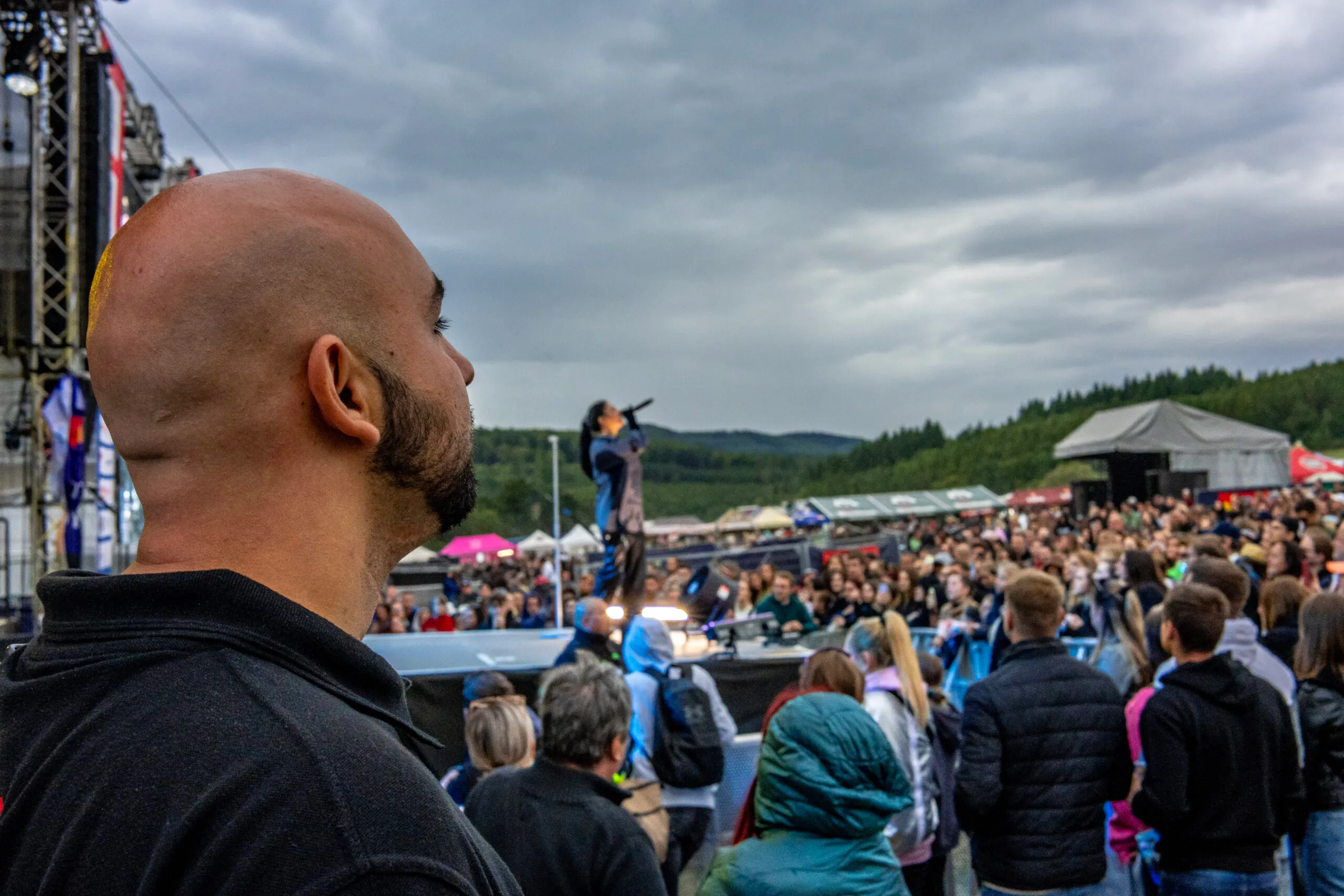
Crowd management covers visitor movement through a venue: capacity, entrance and exit signs, barrier placement, communication and monitoring areas where crowd pressure starts to build.
A larger concert, festival or sports events works like a temporary operation with its own rhythm. People arrive in waves, move between the stage, bars, toilets and transport, and after the programme ends they often leave in the same direction. If the space is not prepared, the problem does not start at the incident. It starts when a visitor does not know which way to go, where to wait or whom to ask.
What crowd management solves
The base is safe and understandable movement of people. The security team therefore monitors where visitors gather, whether passages remain usable, whether queues interfere with main routes and whether information reaches the organiser in time.
- Space capacity: How many people can move in a given part of the site without unnecessary pressure.
- Entrances and exits: Where people arrive, where they pause and how they get out after the programme ends.
- Sectors and zones: How public areas, back-of-house, VIP regime, production and service routes are separated.
- Communication: Who informs visitors, who escalates situations to the organiser and who decides on a regime change.
Capacity and clear routes
The number of tickets sold is not enough by itself. An open site behaves differently from a hall, a city street or a complex festival venue. What matters is the clear usable area, route width, barrier placement, visibility of signage and whether people naturally stop in a certain place because of the programme, refreshments or checks.
Critical points often repeat: entrance corridors, narrow passages, the area around the stage, transitions between sectors, bars, toilets and exit routes. For these places, it should be clear in advance who monitors them and what happens when pressure or a queue starts to form.
Entrance regime and queues
The entrance is the first place where security, service and visitor expectations meet. When people wait for a long time without information, tension grows. When checks are unclear, disputes arise. When a queue extends into a route for other visitors, the problem spreads to the area around the venue.
A well-set entrance regime accounts for arrival peaks, separation of different ticket types, information support and the ability to adjust the number of open check points as the situation develops. The point is not to rush the check, but to keep a process visitors understand.
Dividing the space into zones
At a larger event, it pays to work with sectors. Not to make the site more complicated, but to make clear who moves where and who is responsible for each part. The division helps during normal operation, when searching for missing people, during a medical event and during gradual visitor departure.
- Public zones must be understandable for visitors and well connected to services.
- Non-public zones need permission checks and a clear entrance regime.
- Service routes must remain usable for production, the organiser and connected teams.
- Exit routes should be prepared before the programme ends, not only when people stand up to leave.
How to recognise an emerging problem
Crowd management depends on early observation. The team monitors changes in density, slower people flow, nervousness in queues, repeated visitor questions or places where people start pushing against each other. Programme context also matters: arrival before the main performance looks different from movement between stages or departure after the event ends.
An early response does not have to be dramatic. Often it is enough to open another passage, redirect part of the crowd, add information, strengthen communication at the entrance or ask the organiser to adjust the operational setup. The sooner a situation is handled, the less need there is for hard interventions.
Communication with visitors
People cooperate more easily when they know what is happening and why someone is asking them to do something. At a large event, short, calm and specific information is often more effective than a long explanation. The security team should speak consistently: a visitor should not get three different answers from three workers.
In practice, simple language helps: where to go, where to wait, what is closed, what will open and whom to contact if there is a problem. It pays to avoid dramatic words and wording that increases uncertainty. The goal is to calm the situation, not to show authority.
Cooperation with the organiser and connected teams
The security team is not a separate island. It must connect with production, medical service, the organiser, technical teams and, depending on the event type, other units as well. Before the event, it should be clear who passes information to whom, who decides on a regime change and how situations beyond ordinary stewarding are handled.
For larger events, one coordination point or at least a clearly assigned contact person for each area makes sense. This is not a formality. If information gets lost between radios, the problem on site grows faster than it reaches the person who can solve it.
Technology as support, not a replacement for people
Camera supervision, attendance counting, patrol systems or communication tools can help. But they do not replace a person who understands the space and can assess the situation in context. Technology should give the team a better overview, not create the impression that the event manages itself.
What helps most is the combination of visitor flow overview, clear field reporting and the ability to adjust the operational setup quickly. Data without a decision is not a solution. A decision without information is usually only a guess.
Weather and programme changes
Weather can fundamentally change visitor behaviour. Rain moves people under cover, heat increases the need for water and shade, and a storm requires clear decisions from the organiser. Programme delays, sudden closure of part of the site or a technical fault can have a similar impact.
That is why the procedure should be prepared in advance: who monitors changes, who informs the team and who communicates towards visitors. For visitors, timely and understandable information that helps them decide safely is key.
What should be prepared before the event
- a site map with public and non-public zones,
- described entrances, exits, service routes and exit routes,
- a role breakdown for the security and stewarding team,
- a contact chain for the organiser, medical service and other connected teams,
- a way to communicate with visitors during a regime change,
- a procedure for missing people, medical events and overloaded places,
- a short post-event evaluation so the next edition does not repeat the same weak points.
Conclusion
Safe visitor flow is the result of preparation, an understandable space and a team with clear roles. Crowd management is not a harder intervention against a crowd. It is prevention, communication and the ability to adjust operation early so people know where to go and what is happening.
If you are planning a concert, festival, sports event or city programme, start with the design of the space, entrances and communication. Only then does it make sense to discuss the number of workers. You can find more about operational setup on the event security.