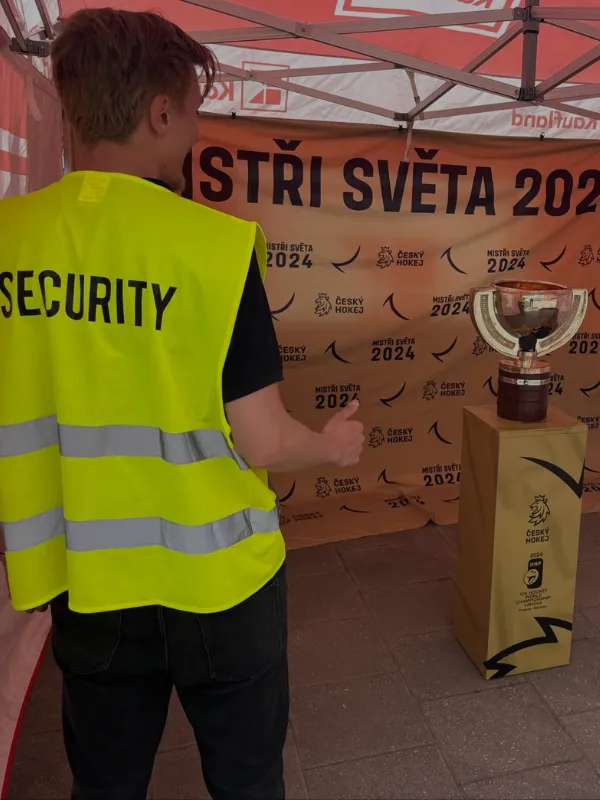
The job of a security guard is often described as two extremes. According to one, he "can't do anything", according to the other, he has almost police powers. Neither is accurate. A security guard is an employee of a private security service who must know the rules of the facility, his legal boundaries and the employer's procedures.
Qualification and preparation
Professional competence, integrity, medical fitness and regular training are important for working in private security. But the certificate alone is not enough. The security guard must be able to communicate with people, keep records, respond to an incident and know when to pass the matter on.
Good preparation includes the legal minimum, health and safety, fire protection, first aid, working with technical equipment and internal rules of a specific facility. Another way is to work at the reception, another way in the warehouse, another way on the construction site and another way at a public event.
A guard is not a policeman
Private security does not have the same status as the Czech police. It cannot routinely demand identification from people in the street, impose fines or conduct criminal proceedings. Its actions are governed by general law, visitor rules, contractual terms and specific situation.
This is precisely why proportionality is important for a guard. The intervention must correspond to what is happening and must not continue when the immediate reason has passed. More serious incidents belong to the police, paramedics or other responsible agency.
Typical areas of work
| Area | The security officer’s role | Limits |
|---|---|---|
| Access procedures | Control of entry, visit, vehicle or vendor permissions. | The procedure must be based on the rules of the site and the instructions of the client. |
| Incident | Calming the situation, protecting the surroundings, summoning the responsible person. | Don't solve things that already belong to the police or medical professionals with your own help. |
| Camera surveillance | Monitoring the entrusted area and passing the record according to the rules. | Do not distribute records outside the designated process and respect GDPR. |
| Documentation | Factual records of incidents, faults and shift handovers. | Do not write assumptions, insults or legal conclusions without support. |
Inspections and baggage control
In shops, sites and at events, the inspection of bags or the inspection of prohibited items is often dealt with. The basis is the person's consent, visiting rules and clear entry rules. If a person does not consent to the inspection, the procedure varies according to the environment and the specific situation.
The warden should not replace the police or force a procedure for which he has no support. He should know when it is enough to refuse entry, when to call the shift manager and when to hand the matter over to the police.
Camera surveillance and confidentiality
When working with the camera system, the security guard often comes across sensitive information. Records, internal mode of the site, codes, movement of people or information about the client do not belong in informal debates or on social networks. Confidentiality is part of professionalism.
The monitored area should be marked and the records should be used only for the intended purpose. If a record needs to be transferred, it is done according to the data controller's rules, the contract and the legal framework.
Ethics and conduct
The guard represents both the client and the security agency. Good manners, calm communication and the ability not to take conflict personally are just as important as knowing the rules. Rude behavior can turn an ordinary situation into an incident.
- Communication: speak briefly, matter-of-factly and without humiliation.
- Adequacy: choose the procedure according to the actual risk.
- Record: record events clearly and without assumptions.
- Delivery: know when to involve the client, police, fire or paramedics.
- Confidentiality: protect information about the site, people and security mode.
What the client commissioning the service needs to know
The client should not assume that "security will handle everything". A private security service works within the contract, facility rules and general legal boundaries. If the client wants access control, camera surveillance, patrols, visitor registration or incident response, these tasks must be clearly described.
A vague assignment puts pressure on improvisation. The worker then does not know whether to reject the person, call the responsible person, just write down the event, or hand the matter over to the police. A well-set service therefore starts with the rules, not with the shift itself.
The practical limit of the guard role
- May explain and enforce the rules of the space, if they are clear and accessible.
- May summon the responsible person or the IZS departments, if the situation exceeds normal operation.
- Must keep a factual record, but is not intended to be a substitute for legal judgment or investigation.
- Should act reasonably, without unnecessary pressure and without humiliating communication.
- To protect information, that learns about the facility, people, technology and security arrangements.
Why is site-specific training important?
The general qualification is only the basis. A security guard at the reception, in a warehouse, on a construction site or at a public event deals with other situations and other responsible persons. That is why, before embarking, they must know the local regime, contacts, entry rules, how to record events and procedures for emergency situations.
It is the local training that reduces the risk that the worker will use a general rule where a specific instruction of the client should apply. Therefore, good service is not only about having a qualification, but also about knowing how to use it in a given space.
Conclusion
The security guard in the Czech Republic has an important but clearly defined role. His work is based on qualification, communication, appropriateness and the ability to hand over the situation to someone with additional authority or expertise. Knowing the boundaries is what distinguishes professional security from improvisation.