Serious workplace violence is a low-frequency but very serious risk in terms of impact. The company should not solve it with panic or a list of movie scenarios. It needs an understandable prevention system, clear roles and the ability to convey information in time to people who can act.
The topic is not only about security. It belongs to the work of management, HR, facility management, reception, internal communication and crisis management. Each of these roles sees a different part of the situation, and it is the linking of information that often decides whether a problem is caught in time.
1. Different types of threat
A serious incident can arise in various ways: from a conflict with a customer, a dispute with a former employee, domestic violence transferred to the workplace, a robbery motive or from long-term unresolved tension within the organization. Each of these scenarios has a different beginning, but a common foundation applies to the business: noticing the warning signs, having someone to pass them on to, and knowing what happens after they are reported.
The aim of prevention is not to suspect every person who is having a bad day. The goal is to capture recurring patterns of behavior, threats, escalating conflicts, rule violations, and situations where multiple weak signals combine into a more serious risk.
2. Role of management and HR
The management of the company must give the topic a framework. Employees need to know that they can report a concern, conflict or threat without fear of being labeled as oversensitive. At the same time, it must be clear that the notification will be assessed objectively, discreetly and without hasty conclusions.
HR and direct supervisors tend to be closest at the first signals. They monitor behavior changes, repeated conflicts, the course of disciplinary proceedings, employee departures and situations where a work problem is combined with a personal crisis. This information only makes sense if there is a safe and transparent process for its transfer.
| Area | What to monitor | How to work with it |
|---|---|---|
| Conflicts | Repeated threats, harassment, coercion or disrespect of boundaries. | Record factually, hand over to the designated person and set the next procedure. |
| Employee departures | A strained termination of an employment relationship, disputes over access or company property. | Coordinate HR, IT, reception and security arrangements for the day of departure and the period after. |
| Visits | Unannounced persons, repeated contact attempts, violation of the visiting regime. | Set reception clear rules and a contact person for escalation. |
| Domestic violence | Risk of private conflict spilling over into the workplace. | Proceed discreetly, protect privacy and involve professional help according to the situation. |
3. Reception, entrances and movement around the building
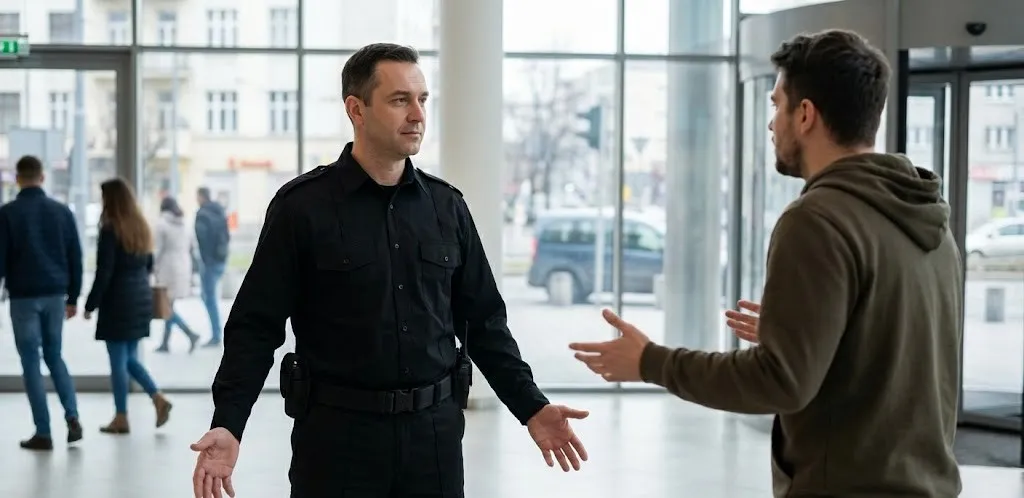
Reception and entry mode are a practical border between public and internal space. The point is not to turn the company into a closed institution, but to have an overview of who comes, who they follow and where they can move. Often the weak point is not in the technology, but in people circumventing the rules out of politeness or routine.
The visiting regime should be simple: announcement, verification, escort in non-public parts, clear rules for suppliers and a quick possibility to consult an unusual situation. If the front desk doesn't know who to call, the company is wasting time just when a calm decision is needed.
4. Crisis plan and controlled sharing
The emergency plan should be specific to the given building and clearly divide responsibilities. It is important for employees to know the practical logic: how to recognize warnings, who to call, how information is passed on, who communicates with the police and who takes care of employees after the event.
For individual roles, it should be clear in advance what information they will receive, who will update them and when they will be activated. This shortens decision-making in a crisis and at the same time maintains order in contacts, technology and responsibility.
5. Internal Communications and Warnings
In an emergency situation, the information must be short, understandable and uniform. The company should determine in advance who initiates the message, which channels will be used to reach the people in the building, and who will communicate externally. Impromptu messages that contradict each other increase stress and complicate intervention.
Training without drama is just as important. Employees need to know their role, points of contact, how to report a suspicious situation and the procedure to follow when instructed by a responsible person. In a crisis situation, they must respect the instructions of the police or other IZS units.
6. Technology as a supporting tool
Camera system, access cards, reception registers, internal reports or emergency contacts can only help if they are linked to responsible persons and checked regularly. Technology without process creates a false sense of security.
During any monitoring, it is necessary to respect privacy, personal data protection and internal rules. Safety measures should be proportionate to the risk and clearly explained to the people they affect.
7. What to do after a serious event
The follow-up phase is often underestimated. The company must count on psychological support, communication with employees, cooperation with the authorities, restoration of operations, work with the media and evaluation of what happened. It should not be about finding a quick culprit, but about managing the consequences responsibly.
Every serious threat or incident should be followed by a structured evaluation. What was reported on time, where information was delayed, who did not know what to do, and how to adjust the plan, training or access procedures.
Conclusion
Preparedness for a serious violent incident does not rely on fear or widely disseminated details. It stands for timely reporting, reasonable visiting regime, linking HR and security, clear communication and the ability to engage professional help. A company that has these basics in place has a better chance of catching a problem earlier and managing a situation that develops quickly.