
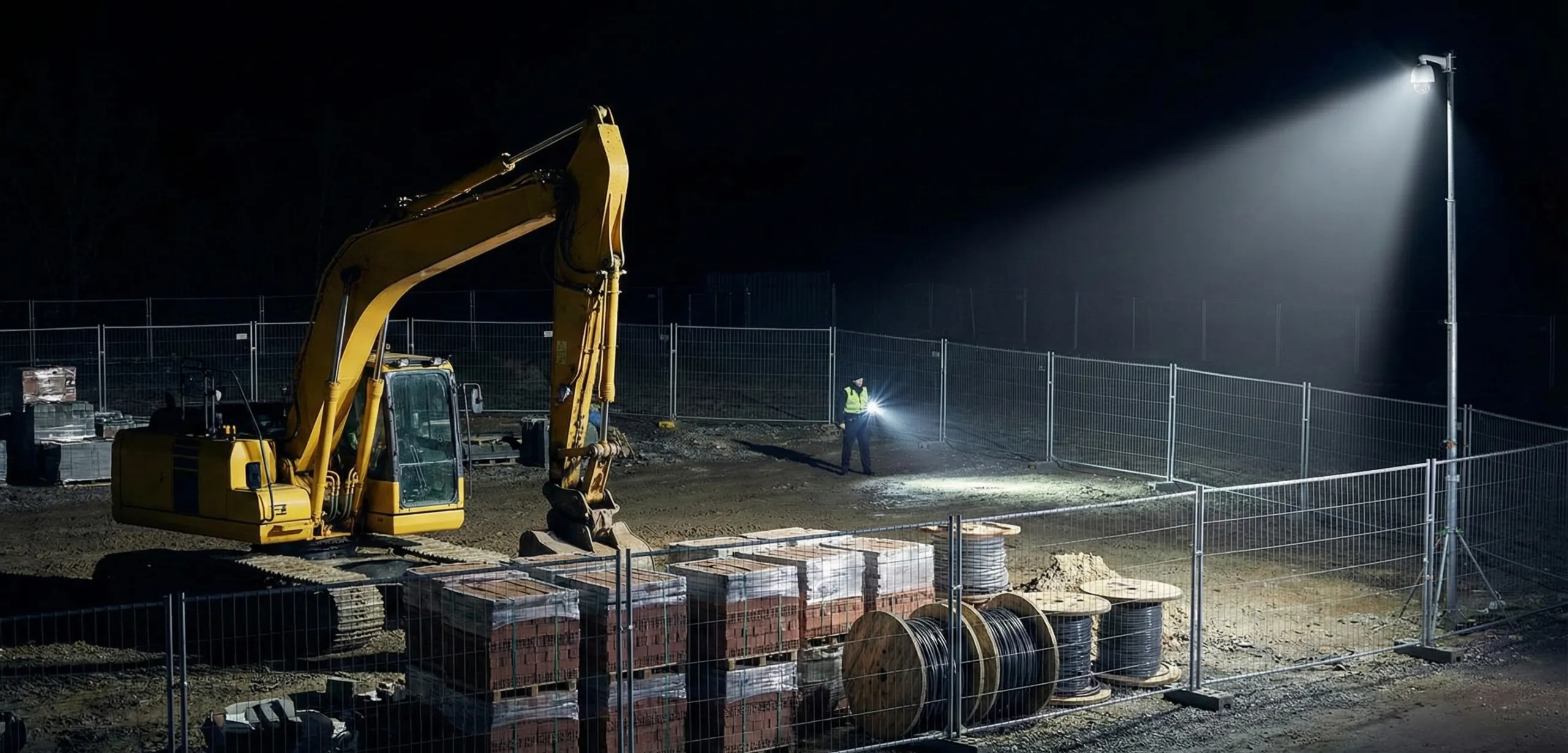
A construction site is a specific environment. During the day, employees, suppliers, technicians and visitors move around in it, after working hours material, machines and fuel remain on site. A fence alone is usually not enough if it is not clear who is entering, what is being checked, and who is responsible for the area after the shift ends.
What is most often lost on construction sites
Items with a quick possibility of removal or resale tend to be risky: tools, cables, building materials, fuel and smaller equipment. With larger machines, the problem is more likely to be damage, unauthorized handling or partial losses, which are difficult to trace with poor records.
It is important not to focus only on the night hours. Part of the losses arise during handovers, during increased movement of suppliers or when the building goes from daily operation to idle mode.
Access procedures and records
Keep clear records of who is on the construction site, why they are there and when they leave. Records of people, vehicles and suppliers can be simple, but must be consistent. Relying on habit at pedestrian or vehicle entrances leaves room for errors and misuse.
- Vehicle entrances: clear authorization, time of arrival and departure, responsible contact person.
- Visits: escort or confirmation from the person expecting the visit.
- Suppliers: rules for loading, unloading and movement outside of main working hours.
- Idle mode: passing on information about what remains on the construction site and what is to be inspected.
Walks and physical inspection
Physical security works best on a construction site when staff have clear instructions. Patrols should check designated areas, changes since the previous shift, signs of tampering, open access points, lighting and risk areas.
It helps with larger constructions patrol system, photo documentation of defects and a brief report for the construction manager or responsible person. Without reporting, recurring issues are easily lost between shifts.
Technology as a supporting tool
Mobile cameras, sensors, lighting, electronic records or remote monitoring can reduce the risk, but do not replace the responsibility of the building regime. The technology should be connected to the response: who evaluates the alarm, who goes to the location and to whom the event is reported.
For temporary buildings, it is also important to think about changes in layout. Fences, warehouses, containers, access routes and risk zones may change according to the phase of the works. Without regular updates, security mode quickly becomes disconnected from reality.
Urban and remote buildings
In the urban environment, unauthorized passage, vandalism, curious people and the movement of people near public routes are more often dealt with. For more remote buildings, reaction time, weaker surveillance of the surroundings and longer sections of the perimeter tend to be a bigger problem. The safety design must correspond to the specific location, not just the type of building.
How to start when the material is already lost
If repeated losses are already occurring on the construction site, it is advisable to first separate conjecture from verifiable information. Write down what is lost, at what time, from which part of the building, who had access at that time and what was the mode of handing over the shift. Without this data, security measures are often set by feel.
The practical first step is usually short security audit buildings: entrances, perimeter, material storage, lighting, movement of suppliers, night mode, cameras and reporting. There is no need to change everything right away. It is important to determine which locations have the greatest impact on losses and where the regimen can be refined quickly.
What to prepare for a service proposal
- Construction-site scope: number of entrances, access routes, fencing and places where material is stored.
- Work rhythm: working hours, weekend operations, night-time quiet periods and changes as construction progresses.
- Risk Items: machinery, tools, wiring, fuel, stored materials or supplier equipment.
- Responsible persons: construction manager, foreman, investor contact person and incident reporting rules.
- Technology: existing cameras, lighting, sensors, mobile surveillance and method of recording.
Common mistake: same mode throughout construction
Construction changes after weeks. Fencing may be the biggest issue in the beginning, then material storage, then technology, cabling or moving subcontractors. The security arrangements should change with the construction phase. What was sufficient for earthworks may not be sufficient when more expensive equipment or finishing materials are on site.
Review the security arrangements whenever the site layout changes significantly. This need not involve a full audit: check that patrol checkpoints remain appropriate, risk areas are visible, and security staff have current information from the site manager.
From our work: construction-site security near Brno
During our regular construction-site security assignment near Brno, the team checked entrances, fencing and material storage areas. They recorded findings and passed them to the client’s designated contact. The case study describes the brief and the scope of work.
For a similar assignment, explore our construction-site security service. If losses recur, start by reviewing access, storage and shift handovers; these areas are covered by a security audit.