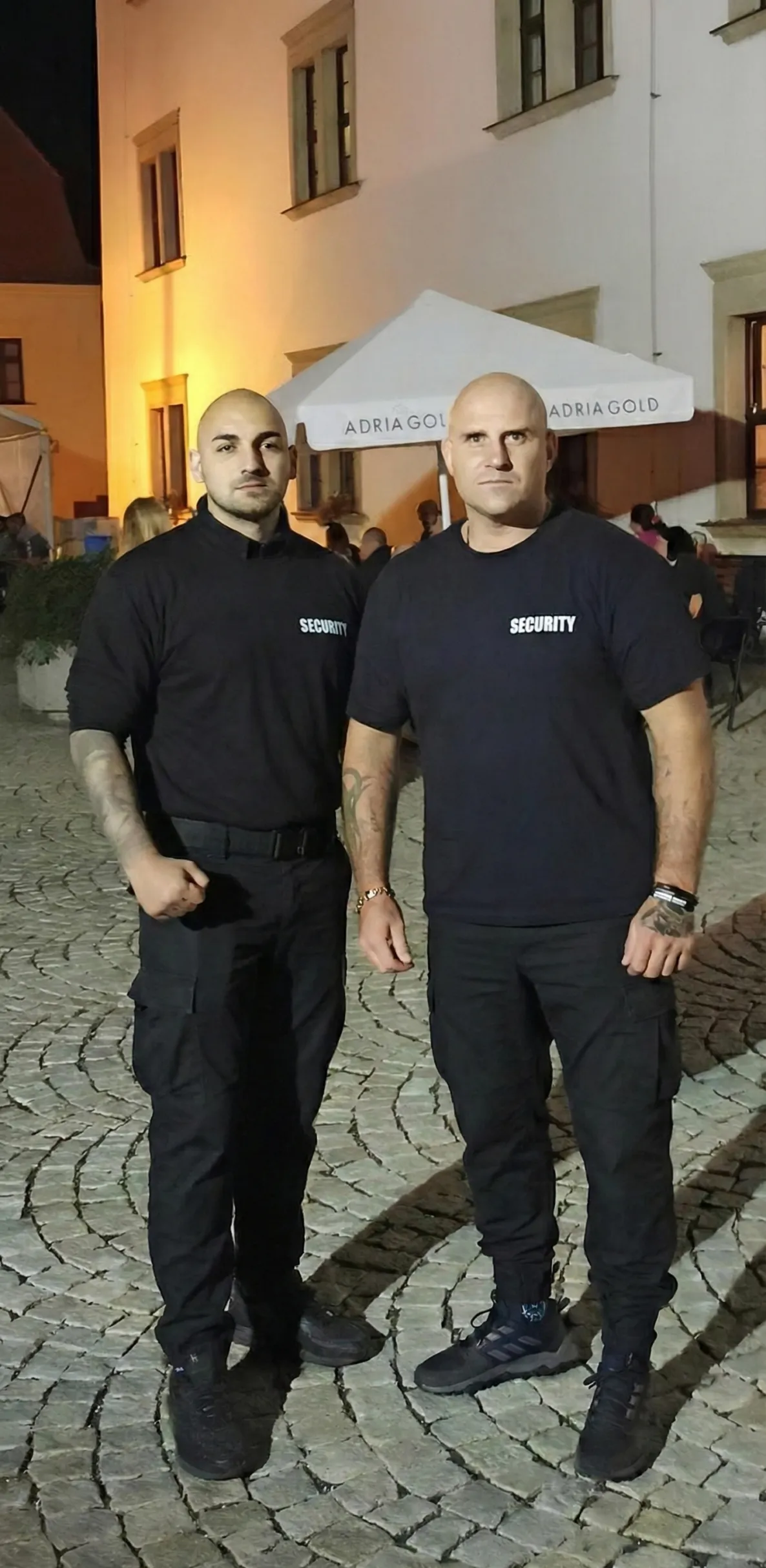
A security guard often encounters a conflict before the police. At such a moment, the ability to read the situation, to speak calmly, to protect the surroundings and to know when it is necessary to hand over the matter to the responsible person or to the IZS units is decisive.
The goal is not to win a verbal battle or show superiority. The goal is to reduce risk, gain time, protect people around and proceed within the limits of the law and the rules of the given site or event.
1. First task: slow down the situation
Aggressive behavior often has several degrees. First comes frustration, raised voice, flouting rules, trying to gain an audience or elicit a response from staff. If a team catches a conflict at this stage, they usually have more options than when a physical attack has already occurred.
Slowing things down doesn't mean giving up on all the rules. It means speaking briefly, keeping a clear line, not raising your voice, and creating space for a decision: the guest can cooperate, leave, or the situation will be passed on according to the rules of operation.
2. Communication without humiliation
Humiliation is a frequent trigger for further escalation. If a security guard is speaking to a person in front of an audience, they must expect the other party to protect their face. That's why a matter-of-fact tone, short sentences and offering a solution outside the crowd helps, if the situation allows it.
- Describe the rule: "You can't block passage here."
- Say the request: "Please step aside."
- State the consequence: "If things don't go smoothly, we'll take it up with the shift manager or the police."
- Don't repeat yourself endlessly: several clear calls should be followed by a pre-arranged procedure.
3. Risk reading
Security does not have to make a psychological diagnosis. But he should perceive changes that increase the risk: shortening the distance, disregarding simple instructions, fixation on a specific person, trying to draw other people into the conflict, threats, destruction of things or sudden silence after previous aggression.
Context is also important. Another way is to work with an upset customer at the reception desk, another with a drunken group in a club and another with a person who repeatedly violates the ban on entry. The team should be able to distinguish when communication is enough and when reinforcement, closing the area, calling the police or medical help is needed.
4. Work in a team
Conflict should not be unnecessarily resolved alone. The second worker can monitor the surroundings, communicate with staff, call the shift manager or ensure that other people do not add to the incident. Teamwork also reduces the risk of one person getting drawn into a personal dispute.
Before the shift, it should be clear who makes the decisions, who communicates with the operator, who calls the police or paramedics and how the incident is recorded. If these things are only dealt with in the middle of a conflict, the pressure and the probability of error increase.
5. Legal and operational boundaries
A private security officer is not a police officer. Acts according to general legal rules, visiting rules, operator's instructions and specific situation. Therefore, every intervention must be proportionate, justifiable and terminated when the immediate risk has passed.
In practice, it is important to stick to a simple principle: first communication, then a clear decision and, in a more serious situation, handing over to the responsible person or the police. The security guard should not improvise where the situation exceeds their role.
6. A person under the influence or in distress
Confused, noisy or erratic behavior doesn't just have to be "drunk". It can be a health problem, psychological crisis, injury or a combination of several factors. The security team is not supposed to make a diagnosis. It should monitor whether a person communicates, breathes without obvious difficulties, maintains stability and is not a danger to himself or the environment.
If the condition is unclear or worsening, medical help should be called. After the conflict, it is necessary to monitor whether the person has been injured or needs further care. This part of the job is just as important as calming the situation down.
7. Incident record
The record should be factual, brief and without personal judgments. It describes what the worker saw, heard and did. It should not contain assumptions, insults or conclusions that belong to the police, doctors or courts.
| Less suitable | More suitable |
|---|---|
| "He was completely off." | "The person was unresponsive to repeated prompting, slurred speech and had an unsteady gait." |
| "He wanted to fight." | "The individual raised his voice, approached the worker and repeatedly refused to step aside." |
| "We had to remove him." | "After refusing to comply with the instruction, the person was referred to the shift supervisor and then escorted out in accordance with the visitor rules." |
8. Post-conflict team care
A difficult conflict does not end when the person leaves. The team should briefly review what happened, what worked, where the risk arose, and whether there is a need to adjust the rules of operation. If there has been a serious incident, injury or significant stress, additional support should be available.
Conclusion
Dealing with an aggressive person requires calmness, clear rules, team coordination and knowledge of one's own boundaries. A good security worker does not try to escalate the conflict or win by force. They try to reduce risk, protect the environment, adhere to the law and hand the situation over to someone with additional authority or expertise in a timely manner.