
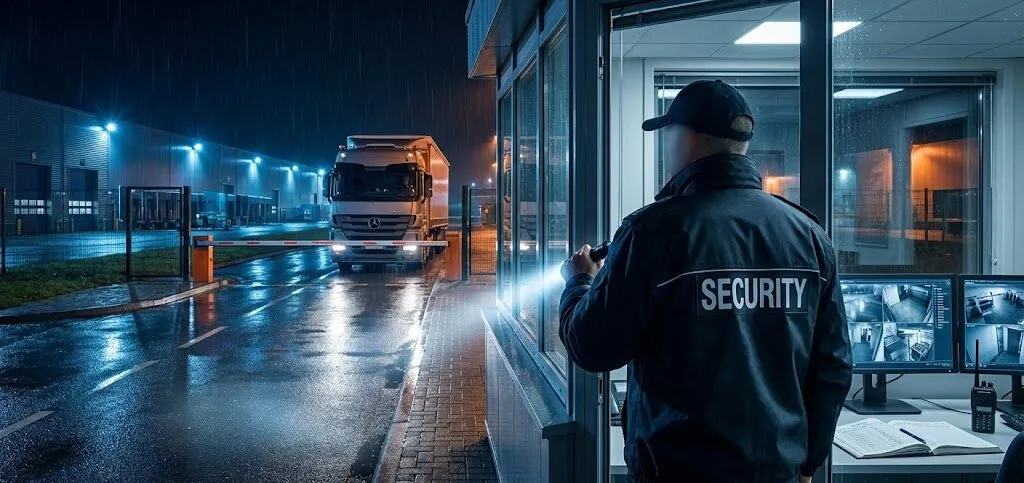
When securing a site, the question often arises as to whether a camera system is enough, patrol system or physical security. Each layer solves a different task. It decides what the on-site security should actually monitor, control and deal with in the event of an incident.
Where cameras and other technologies win
Camera systems (CCTV) and electronic security (EZS) have the upper hand in continuous monitoring of large areas.
- Evidence: the record is an objective witness for the police and the insurance company.
- Low operating costs: after the initial investment it is mainly about service and supervision.
- Remote supervision: thanks to PCO, one operator can guard multiple sites.
Where the guard patrol monitoring system makes sense
A patrol system records checkpoints and patrol times. Supervisors can check whether an officer followed the agreed route. The record alone does not show how thoroughly each location was inspected.
- Performance check: the client or the shift manager can see that the checkpoints have indeed been serviced.
- Discipline of rounds: reduces the risk that the service will "sit" in one place.
- Event history: helps to trace back when which part of the site was checked.
What is important, however, is what the guard patrol monitoring system cannot do: it does not stop the offender, it does not solve the visitor at the entrance and it does not replace the decision of a person in an incident.
Where physical presence is irreplaceable
The camera has one major limitation: it records an event or alerts to a change, but does not resolve it itself. It does not ensure communication with the visitor, does not check the open entrance, does not provide first aid and does not pass information to the IZS units.
Physical security delivers immediate response and prevention:
- Preventive effect: the visible presence of the guard reduces anonymity and increases control over the space.
- Flexibility: a guard can check for a suspicious sound out of range or check a locked room.
- Human factor: at the gatehouse or reception, the guard also fulfills an informational and representative role.
How to decide in practice
- When you need proof and supervision: cameras and related technology.
- When you need to verify that officers complete their patrols: guard patrol monitoring system.
- When you need to react, communicate and discourage: physical security.
- When the site is extensive or multi-layered: a combination of all three.
Verdict: hybrid security
In practice, the combination of all three layers is most effective. For example in logistics premises:
- Smart cameras guard the perimeter and raise an alarm when breached.
- Patrol system monitors that ramps, gates and other critical points have actually been checked.
- Operator or guard will verify the alarm to rule out a false alarm.
- Physical security arrives at the location, verifies the situation and, as necessary, communicates with the responsible person or IZS units.
If you are dealing with a larger site or logistics, this article also follows on site security audit and article logistics and warehouses: the most common risks.
Model decision situations
For a smaller office, an access system, a basic camera at the entrance and a clear visiting regime may be enough. In a warehouse with night operations, physical reaction, rounds, checking ramps and handing over shifts are already important. During construction, the layout of the site changes, and technology must take into account that fences, containers and risk areas move according to the phase of the work.
Therefore, decision-making should be based on operations, not popular technology. If the main risk is unknown movement of people, entrances and visible control are addressed. If the main risk is late detection of the incident, surveillance, patrols and reaction time are addressed. If the main risk is a questionable course of events, the record, access to it and evaluation rules are addressed.
Questions before buying technology
- Who evaluates the alarm? The camera or sensor alone does not decide what should happen.
- Who will arrive or respond? Without a reaction script, the technology is just a notification.
- Who has access to records? Camera surveillance must respect the rules of the data controller and the protection of personal data.
- How are patrols verified? A guard patrol monitoring system should provide verifiable checkpoint records, rather than just a feeling of control.
- What happens in the event of an outage? Need to know how to deal with a breakdown, poor connection or busy shift.
A camera tower on a construction site: when it is enough and when not
A mobile camera tower is often offered today as a cheaper substitute for a guard on construction sites. For a remote site with a clear perimeter and little movement of people it can make sense: the tower deters casual thieves and records an incident. But it does not solve what costs the most money on a site: the morning rush at the gate, supplier records, subcontractor checks and an on-site response within minutes.
In practice, a combination works best: physical security at risk times (nights, weekends, phases with more expensive material) and technology for the rest. How the regime is built by construction phase is described on the construction site security page.
Why solutions are often combined
Most sites do not need just one layer of security. The camera will help to find out what happened, the guard patrol monitoring system will verify that the inspection has taken place, and the physical security will ensure response and communication. If one part is missing, the system may look good on paper, but in an incident it will fail on a simple question: who is going to fix it now?
The combination should match the risks. A small office building and a warehouse operating overnight need different arrangements. What matters is how an alert leads to a responsible person, a decision and a record, rather than the number of technologies installed.