Event security planning translates the risks, venue and programme into specific responsibilities. It defines who makes decisions, who covers each zone, how information is passed on and what should happen when normal operations become an incident. It is neither a universal form nor a document that can simply be written and filed away.
What is an event security plan?
A security plan for a cultural, sports or social event is a management document. It connects what is known about the venue, programme, visitors, suppliers and possible emergencies with the way the event will actually be staffed and operated.
The best plan is not the longest one. It is current, has a clear owner and gives the people concerned usable instructions. It may be concise for a smaller event. The amount of coordination required usually grows with the number of zones, suppliers, parallel programme elements and visitors.
Securing a mass-attendance event therefore starts not with a headcount, but with a description of operations, responsibilities and decision-making links. Only then can posts and a staffing proposal be prepared.
An event security plan is not the same as an operational briefing
| Event security plan | Operational briefing |
|---|---|
| Describes the system, risks, roles, zones, dependencies and decision-making procedures. | Gives a specific team concise instructions for a particular shift or area. |
| Is prepared in advance and updated when the event changes materially. | Takes place shortly before deployment and also covers current operational changes. |
| Is used by the organiser's management, production, security and other responsible people. | Each worker receives only the information needed for their role. |
| Provides the basis for post assignments, contacts, maps and scenarios. | Confirms that people understand their post, reporting route and the limits of their responsibility. |
A briefing therefore simplifies the plan for the people on the ground, but it does not replace it. If an entrance, the capacity of part of the venue, the programme or an access route changes shortly before opening, merely announcing the change verbally is not enough. The responsible person should check how it affects the dependencies in the plan and pass the change to every team concerned.
Checklist: what should an event security plan contain?
1. Event identification and document control
- event name, venue and date, including setup, opening, programme and the end of operations,
- the organiser, venue operator and owner of the event security plan,
- the current document version, date of the latest change and a list of people who received it,
- main contacts and their deputies in case they are unavailable.
Simple version control prevents production, the stewarding service and security from working from different versions. Older maps and schedules should not remain in circulation without clear labelling.
2. Operational description of the event
- programme type and expected course of the day,
- visitor peaks, intervals, movement between stages or sectors and final departure,
- public, non-public, technical, partner, VIP and delivery zones,
- suppliers, performers and other groups with different access arrangements,
- venue constraints, neighbouring operations, transport and other conditions that may affect security.
The aim is not to copy the production schedule. The security section should identify the times and places where the load on the venue or the access regime changes.
3. Map of the venue and movement flows
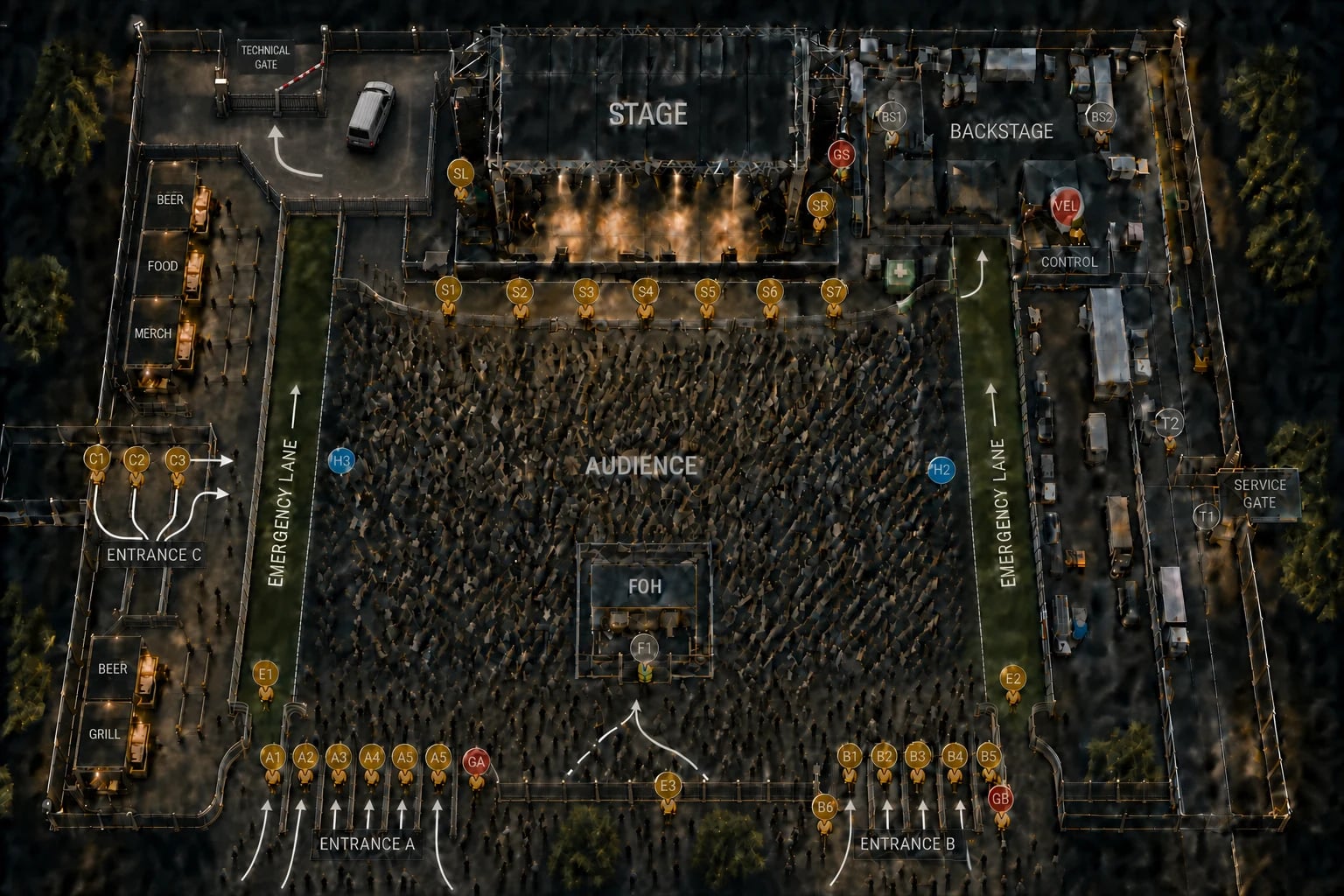
The plan should use an up-to-date map. It should be clear even to someone unfamiliar with the venue and should distinguish normal visitor movement from service traffic. Depending on the event, it should identify in particular:
- entrances, exits, queues, ticket offices and screening points,
- sector boundaries and non-public zones,
- pinch points, crossing flows and places where people naturally gather,
- vehicle and access routes that must remain usable by specialist responders,
- posts for management, medical provision and other responsible teams.
Specific escape, fire safety and evacuation arrangements must follow the documentation and specialist assessment for the venue. A general map from this checklist cannot replace them.
4. Risk assessment and decision triggers
A risk assessment should not end with a list of general threats. For every relevant scenario, it should be clear how it is prevented, what signs tell the team that conditions are deteriorating, who receives the report and who decides the next step.
| Item | Question for the organiser |
|---|---|
| Situation | What could realistically change or go wrong in this venue and programme? |
| Prevention | What measure reduces the likelihood or impact? |
| Trigger | What observable condition triggers a report or decision? |
| Owner | Who monitors the situation and who has authority to decide? |
| Escalation | Who receives the information, and when is specialist assistance involved? |
| Record | What is recorded after the event, and who receives the output? |
Depending on the event, examples may include an overloaded entrance, a medical incident, conflict, a sudden change in weather, a partial operational failure, a blocked route or an unexpected programme change. Specialist intervention, medical, fire safety and evacuation procedures belong to the relevant professionals and services, not in a general online template.
5. Allocation of roles and responsibilities
Four details should be stated for every important area: who decides, who performs the task, who receives reports and who deputises for the responsible person. The organiser, venue operator, production, stewarding service, security, medical provision and technical suppliers must be clearly distinguished.
Stewarding and security roles are not interchangeable. Stewards typically help with information, wayfinding, tickets and smooth operations. The security team performs the agreed duties for protecting people and property, managing access or handling incidents within the limits of its role. Responsibilities must reflect contracts, visitor rules and the specific conditions of the event.
The organiser's specific duties depend on the event type, venue, legal regime, relationship with the venue operator and any conditions imposed by public authorities. This article does not determine them; only requirements verified for the particular event with the relevant professionals and institutions should be transferred into the plan.
6. Entrance, accreditation and visitor arrangements
- who may enter each zone and under what rules,
- how visitors, staff, suppliers, performers and deliveries are separated,
- where entrance rules and prohibited items will be communicated to visitors,
- who handles an invalid ticket and who handles a security incident,
- how issued accreditations are recorded and who may approve an exception.
The rules must be workable in both space and time. If the plan requires a check that the proposed number of lanes or staff cannot manage, the problem will merely move into the queue outside the venue.
7. Crowd management plan
Crowd management planning is not merely a response to a dense crowd. It describes the normal movement of people from arrival to departure and states where operations are monitored, who reports a change and which pre-agreed measure the responsible person may use.
- arrival waves, queues and how visitors are divided before screening,
- movement between entrances, stages, audience areas, refreshments and facilities,
- places with limited throughput and how they will be monitored continuously,
- changes in demand at the start of the programme, during an interval, when the audience moves and at the end of the event,
- consistent and clear communication of changes to visitors.
Specific capacities, barrier designs, escape routes and procedures for exceptional crowd movement must follow a specialist assessment of the venue. The event security plan should translate these approved inputs into roles and operational instructions.
8. Communications and escalation tree
Every worker needs to know who receives a routine update, who receives an incident report and how to tell that the responsible person has received the information. The plan should include primary and backup communication methods, channel allocation and contact details for role leads.
A report should be concise and factual: where the situation is happening, what has been observed, who is involved, the current risk and what assistance is required. Assumptions and unverified conclusions can complicate subsequent decisions.
A separate article explains how event security works with the emergency services.
9. Staffing and post plan
There is no single safe universal ratio that answers “how many security staff does a festival need?” or “how many stewards does an event need?”. The same attendance can create entirely different requirements for an intimate programme in one hall and a site with several entrances, stages and non-public zones.
Staffing is built from the specific tasks:
- how many posts must operate at the same time and during which periods,
- which points require a permanent presence and which require mobile supervision,
- who leads the shift, communicates with the organiser and can respond to a change,
- how breaks, rotations, arrivals and shift handovers will be covered,
- whether visitor entry, the programme, deliveries and the departure of another part of the audience overlap at a particular time.
The security staffing calculator can provide an indicative starting point. Someone must still compare the result with the map, posts, concurrent activity, risks, venue requirements and any conditions set by public authorities or specialist partners.
10. Briefing, readiness check and change control
- role leads confirm the current version of the map, contacts and posts,
- workers physically take over their area and confirm how they report an incident,
- communications equipment and backup connections are checked,
- changes to the programme, weather or venue are recorded and passed to every affected role,
- the event is followed by a handover, incident records and a short review.
For a more complex event, it helps to walk team leaders through several decision scenarios in advance. This is not specialist intervention training; it checks whether everyone understands the responsibilities, information handover and the point at which the relevant specialist or service becomes involved.
Quick document outline to copy
- Event identification, plan owner, version and distribution.
- Programme, operational phases, visitor groups and suppliers.
- Map of zones, entrances, movement flows and access routes.
- Risk register, preventive measures, triggers and escalation.
- Matrix of roles, responsibilities, contacts and deputies.
- Entrance, accreditation and visitor arrangements.
- Crowd management and visitor communications.
- Communications plan and links to specialist assistance.
- Staffing schedule, posts, shifts and team leadership.
- Briefing, readiness check, changes and post-event review.
Common preparation mistakes
- The plan is prepared too late. Suppliers then receive a brief that can no longer be incorporated sensibly into the venue or schedule.
- The document has no owner. Changes happen, but no one monitors their impact or distribution.
- Staffing is based only on attendance. There is no connection to posts, concurrent activity, leadership or rotations.
- Roles overlap. Stewards, security and production each expect someone else to handle the same task.
- The plan remains with management. Workers on the ground do not know the important outputs or reporting route.
- A general template is presented as specialist approval. It is not connected to the specific venue, legal requirements, fire safety, medical provision or emergency services.
When to involve a security provider
An event security provider adds the most value when it can comment on the map, entrance arrangements, allocation of posts and communication links before the production plan is finalised. A shift can be assembled shortly before an event, but a poorly positioned entrance, missing corridor or unclear responsibility is harder to correct.
For a useful initial consultation, prepare the date, venue, programme, expected operations, working map, zones and known risks. You can then use the contact form to confirm the service scope, the division between stewarding and security roles, and the staffing proposal. The result must still be aligned with the venue operator and every specialist or public authority involved in preparing the particular event.