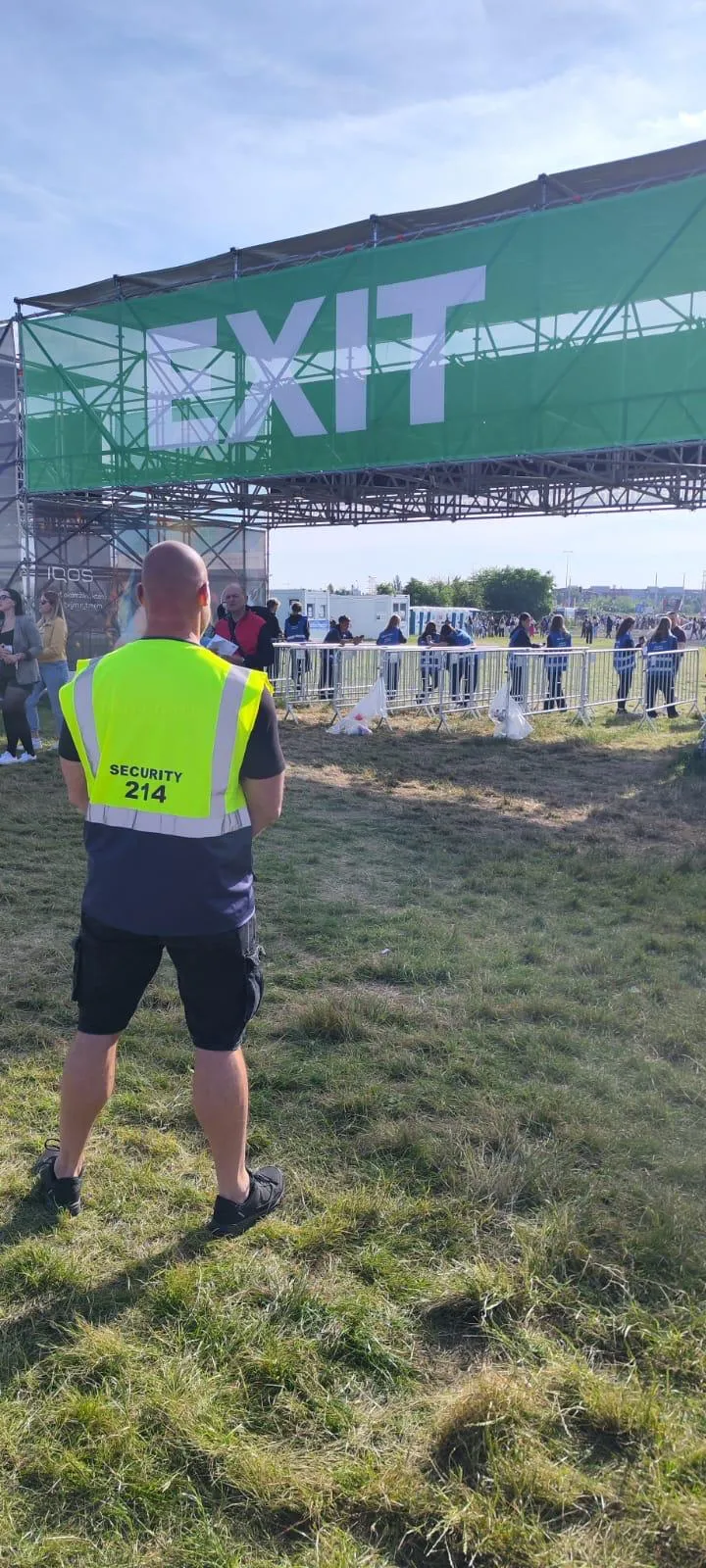
At a large event, a medical problem, a congested passage and a visitor conflict can occur at the same time. Security must coordinate information and action with the organiser, medical staff and other services as well as respond to individual incidents.
The answer is not just in the number of people. Coordination matters: event security must work as part of the wider system, with clear responsibilities and coordination.
The Czech Ministry of the Interior's security standards provide guidance for organisers. They do not replace an event-specific plan, the organiser's decisions or instructions issued by the Police of the Czech Republic, the fire and rescue service or the emergency medical service within their respective remits.
In short: for a larger event, it must be clear in advance who handles the entrances, who holds the sector, who communicates with the organizer and when the situation is handed over to the IZS units. If you are just planning the scope of the service, the page follows event security, local variant event security Brno and practical examples in the section security services reference.
Who works together to secure an event?
At a large public event, they operate by default:
- Police of the Czech Republic – public order and the resolution of situations falling under its purview
- Emergency Medical Service (EMS) – medical care and professional patient handover
- Firefighters (HZS) – fire protection, technical rescue work
- Event security (SBS) – security of entrusted areas, entry mode, movement of visitors and support of the organizer
Each component has a different role and different powers. Security is not the police. He should know the rules of the event, visitor rules, its own contractual scope and boundary, when the matter needs to be handed over to the responsible person or components of the IZS.
Action safety plan - basis of coordination
A larger public event should have prepared security documentation to the extent appropriate for the type of event. It is not just a formal document. It is a practical agreement about who is responsible for what and how information is communicated.
Documentation typically addresses:
- responsibilities of the organiser, security team, medical provider and venue operator
- contact persons and how to escalate events
- visiting rules, access procedures and basic rules for the movement of people
- general mode for emergency situations and communication with visitors
- follow-up to the arrival and work of professional components
Command in a crisis situation
Who is in charge when something serious happens? It depends on the nature of the situation.
In the case of a common security incident, the person responsible for security or the organizer leads the first response according to the agreed regime. At the same time, it must be clear when the situation is handed over to the police or another component.
In the event of a medical incident (nausea, injury, unconsciousness), the medical staff takes command. Security will clear the passage, protect the space and coordinate access for emergency services.
In the event of an emergency, the relevant components of the IZS take over the decisive role. Security fulfills a support function, helping with the space, passing on information and the movement of visitors according to the instructions of the responsible persons.
An experienced security manager knows when to lead his own team and when to support the component that took over the incident.
Communication in the field
You can't just rely on normal phone calls for a bigger event. Noise, network load and the movement of people complicate the transmission of information, so the communication mode must be agreed in advance.
In practice, this means determining responsible contacts, resources used, backup options and rules for reporting incidents. Each coordination participant should know when the situation is solved by his team and when he passes it on to the responsible person or component with the relevant authority.
Every worker in the field should know to whom to report an incident, how to briefly describe the situation and when not to continue alone, but to hand over the matter to the shift leader or organizer.
How is the briefing before the event
Before the opening of the area, there should be a briefing of the responsible people. Its scope depends on the size of the event, but the purpose is always the same: to unify information, roles and expectations.
The briefing deals with:
- distribution of sections and responsibilities
- current operational information, such as weather or program changes
- places where a higher load of visitors is expected
- procedure for handing over the incident to the shift leader, organizer or IZS
- contact persons and communication mode
A short and to-the-point briefing is often more valuable than a formal meeting without a clear outcome. People in the field need to know what is expected of them and to whom to pass the information on.
After Action Review - what we learned
A debriefing is held after the event. What worked, what didn't, where there were delays, what to do differently next time. In English it is called After Action Review (AAR).
Without evaluation, the same mistakes are easily repeated. The point is not to find the culprit, but to improve the next briefing, entry mode, communication or division of responsibilities.
Conclusion: Security is not an island
Event security should not be isolated from other components and only communicate internally. At a big event, it is part of the system. Her job is to reliably do her part, keep information moving and hand the situation over to whoever has the authority or expertise to take the next step.
Such an approach helps keep the action readable, safer and manageable even when several things are happening at the same time.