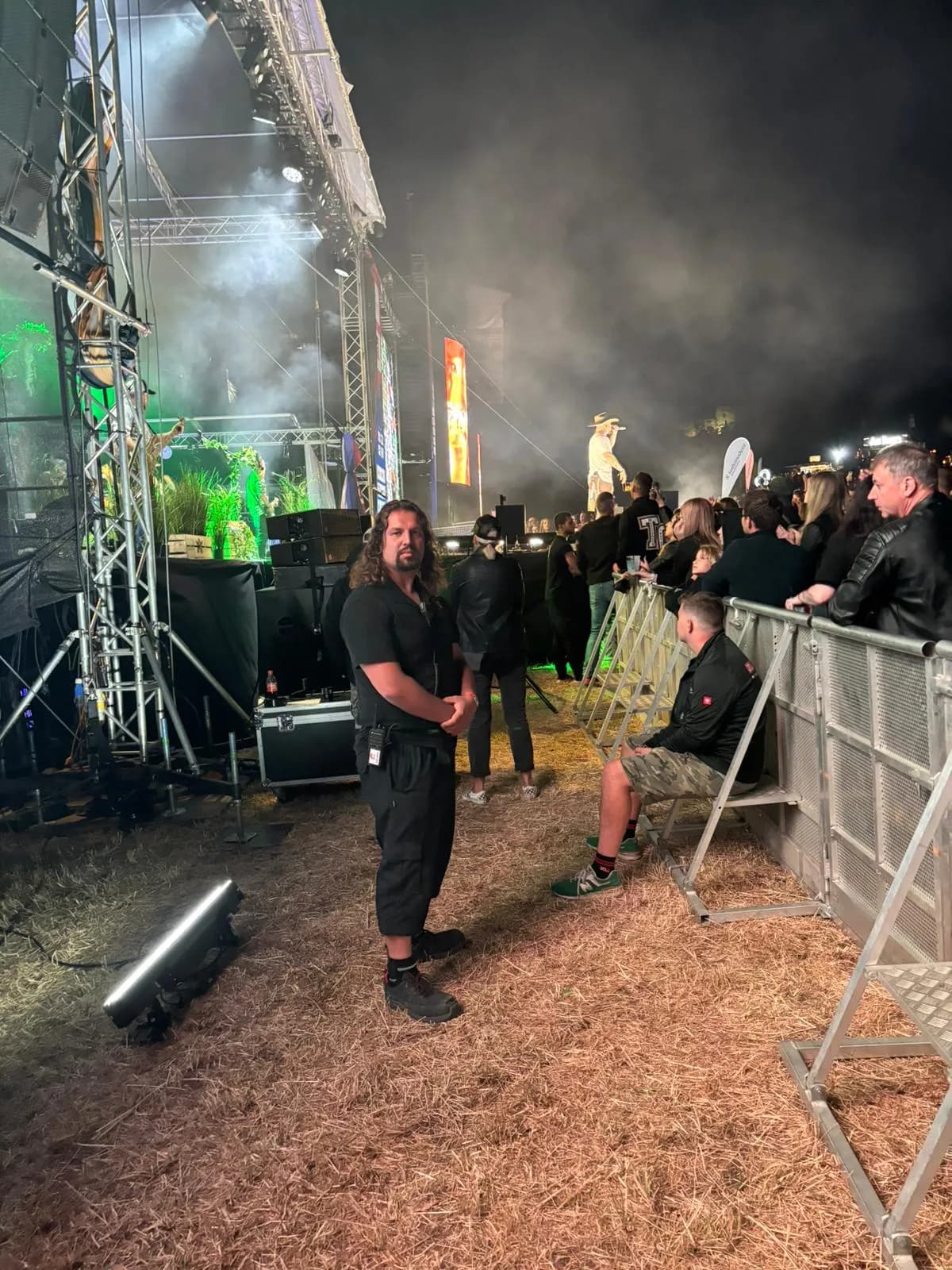
Hrady CZ 2025 were, according to the official program, the 20th anniversary of the festival series, which took place in eight weekend stops: Tocnik, Kuneticka hora, Svihov, Hluboka nad Vltavou, Veveri, Hradec nad Moravici, Bouzov and Bezdez. From the point of view of the security service, this is a different type of work than an isolated event. Not only the date and city change, but also the character of the location, access routes, division of space, continuity with the technical background and the rhythm of the movement of visitors. Bravion participated in the project in cooperation with ARES Group.
Why is a similar series operationally demanding
For a weekend festival series, you can't rely on a once-set model to work unchanged all summer long. Each stop has different terrain conditions and a different logic of movement. The historical location itself creates restrictions that are essential for the security regime: different access of equipment, different width of corridors, different division of entrances and other points where delays or pressure can arise.
In addition to the physical location itself, operational details are also changing. The work looks different in a space with a natural elevation, different in a flat undercastle, different in a location where the visitor background and operational routes are more intertwined. It is all the more important that the security team does not come "just to work a shift", but to quickly understand the specific mode of the given stop.
Deployment model: repeated weekends, not a continuous tour
It is also important to specify the work mode itself. It wasn't a case of one team traveling non-stop for eight weekends straight and living the entire season on the festival circuit. In reality, it was repeated weekend deployments according to the needs of specific stops. People had their normal schedule during the week and typically drove to the event in a Friday-Saturday model. This is an important difference even from a professional point of view: performance, logistics and responsibility are planned differently for a continuous tour crew and differently for a weekend involvement according to the needs of a specific event.
Role Bravionu v projektu
Bravion participated in the project in cooperation with the ARES Group. In practice, this meant taking over the briefing for a specific weekend, respecting the logistics and division of responsibilities of the main partner, arriving ready at the site and working so that the individual parts of the security operation were connected to each other.
With a model like this, it's important for the team to understand their role. The goal is not to create a parallel way of management or to bring your own improvised system on the spot. The goal is to follow up on the set operation, maintain discipline and be a legible part of the whole.
What has to be mastered every time again
From a professional point of view, work with repetition is essential for a similar series. Although the specific environment changes every weekend, the security service has to manage the same core tasks every time:
- quickly find your way around the location and follow up on the briefing for a specific stop,
- to understand which parts of the space require increased attention in terms of entrances, visitor movement or background,
- maintain communication discipline and convey information clearly without unnecessary noise,
- operate as a follow-up part of a wider security regime, not as an isolated team with no follow-up.
What changes
Location, division of space, access routes, visitor flows and the connection between public and non-public parts of the event.
What must remain the same
Punctuality, comprehensible acceptance of assignments, disciplined communication and legible service performance without improvisations outside the framework of the regime.
What risk is typical for a similar project
The main risk in a weekend series is not one extraordinary event, but operational inconsistency. If the team adapts differently each time, does not maintain the same level of communication or does not transfer the basic standard of work to the new location, it will quickly start to show at the event. In the visitor, it can be recognized by a queue, unclear movement, delay at the entrance or poor coordination in sensitive areas. For the organizer, this will be reflected in the fact that, instead of calm traffic, they have to solve things that should have been solved long ago.
A similar project depends on operational discipline. It is not enough to be "used to the festival". It is important to accept the assignment, understand the specific location and work the weekend in such a way that the service remains legible, regardless of whether you are working at a castle on a hill or in a more open area.
What to take from this reference
CZ castles are an example of repeated weekend work in variable conditions. For a series spread over eight stops, the same fundamentals are essential as for other events with a high movement of visitors: a clear assignment, respect for the agreed schedule, the ability to quickly find your way around and disciplined performance of the service without unnecessary detours.
If you're tackling a multi-location festival, city event, or weekend series, it makes sense to set the safety mode to work even when the terrain and traffic changes. You can find more about this on the page event security.