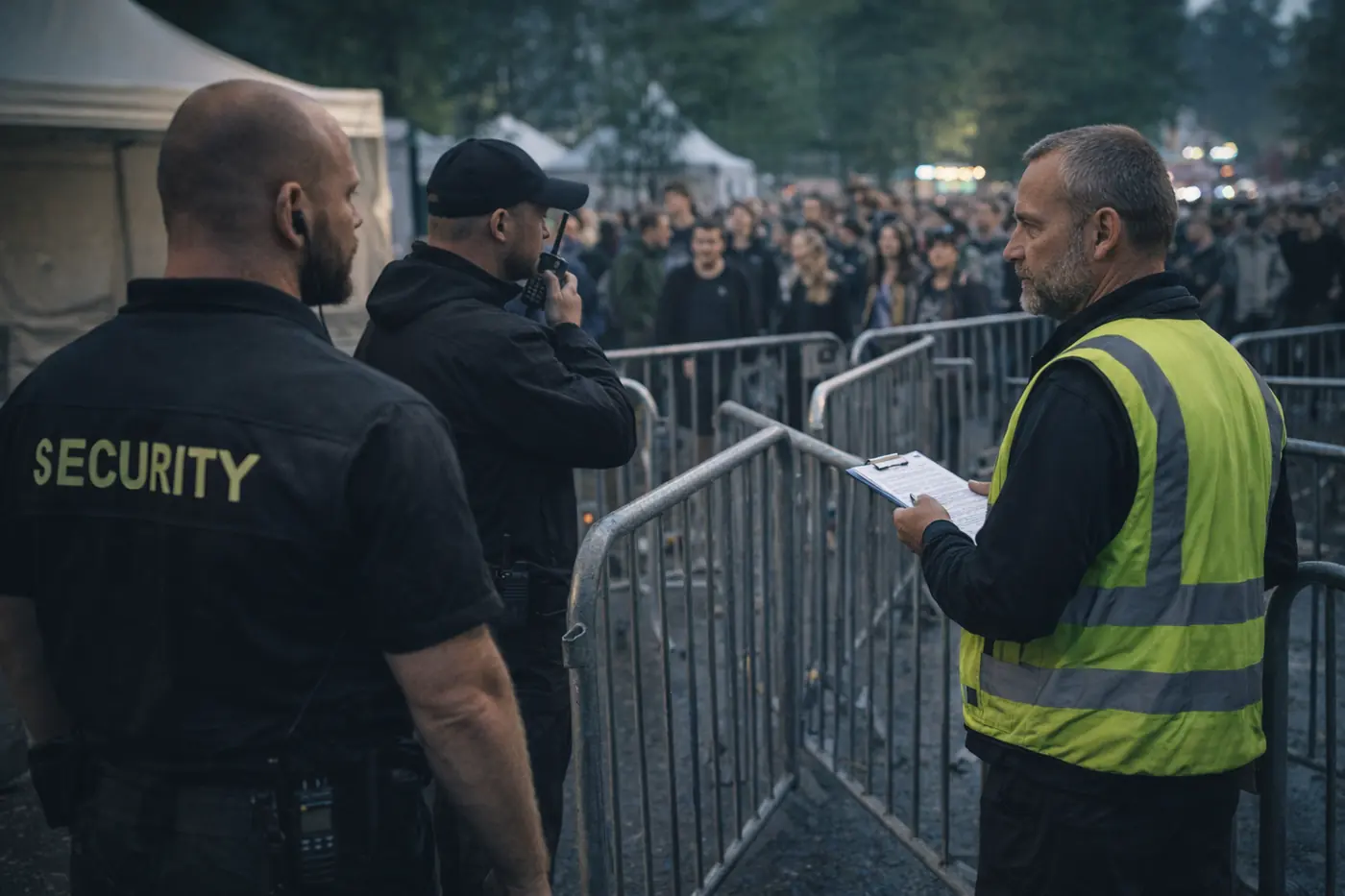
Public event security requires preparation, clear responsibilities and agreed entrance procedures. The team must know how to communicate with visitors and when to call the organiser, medical staff or emergency services.
Private security service is part of the operation at the event. It helps with entry control, space surveillance, information transfer, conflict response and support for the organizer in situations where a quick and calm decision is needed.
A well-prepared public event relies on clear responsibilities, access management, visitor communication and timely involvement of organisers, medical staff or emergency services.
1. Clear division of roles
The first question before the event is simple: who is responsible for what. The organizer deals with the overall organization, program, visitor rules and relationship with the authorities. The security team ensures the assigned tasks according to the contractual scope, the organizer's instructions and the rules of the event. Medical supervision, production, technical team and site operation have other separate roles.
If this division is not clear, the problem will only become apparent in the load. Someone changes the entry mode, someone lets visitors through a different route, someone doesn't know who to report the incident to, and the security team then deals with the operational chaos instead of the risk itself.
| Area | What is to be predetermined | Practical meaning |
|---|---|---|
| Entrances | Rules of entry, control, accreditation and refusal of entry. | The staff proceed in the same way and there are no unnecessary disputes. |
| Area | Responsibility for individual zones, passages and service points. | The team knows where to be present and who to pass on information to. |
| Incidents | Who decides on escalation to the organizers, health workers or the police. | Vital information is not kept by one person in the wrong place. |
| Communication | Channels, contact persons and change transfer mode. | Changes to the program reach the people who work according to them. |
2. Legal boundaries of security
Private security in the Czech Republic does not have the same status as the police. Its activity is based on general legal regulations, the contractual relationship with the organizer, the visiting rules and the specific situation on the spot. This needs to be reflected in training and communication with visitors.
In practice, security staff should not base their authority on an impression of unlimited powers. They should know the event rules, be able to explain them, act proportionately and promptly refer the matter to the responsible person or competent authority if the situation goes beyond the normal scope of stewarding services.
3. Visitor rules support safe operations
Visitor rules are a practical guide to entry, checks for prohibited items, conduct on site, leaving the venue and responding to breaches. They should be clear, accessible and consistent with what the security team is expected to do.
A frequent weakness is the difference between the rules on paper and the reality on the ground. If the visiting rules provide for a certain control, but the entrance is not prepared in terms of personnel or technology, there is pressure for improvisation. In the same way, you cannot ask security to follow a procedure that the guests did not have the opportunity to know in advance.
4. Risk assessment without unnecessary details
The risk analysis should be specific to the given action and must be adapted to the real operational setting. The organizer should work with the type of program, the expected audience, the capacity of the space, traffic, weather, availability of health professionals, continuity with the surroundings and experience from previous years.
The result should not be a long document that only the author understands. Important conclusions must be translated into shift instructions, deployment of people, entry mode, communication plan and decision-making powers. Otherwise, the risk analysis will remain a formal attachment with no influence on the course of the event.
5. Crowd management in practice
Crowd control starts long before the entrances open. This includes capacity, routing of people, queues, passageways, visible signage, working with the program and the ability to recognize in time that a place is becoming overcrowded. The security team must be able to pass on the information and get a decision on it.
The crowd is not a problem in itself. The problem arises when people have nowhere to go, don't understand the instructions, or the information between the organizer and the security team is passed on late. Therefore, simple communication, clearly marked routes and clear responsibility for places where people naturally congregate are important.
6. Cooperation with IZS and other partners
In the case of public events, it is necessary to take into account the follow-up with the emergency medical service, the police, the fire brigade, the municipality, the administrator of the area and other partners depending on the type of event. It does not mean that every worker must know every detail. This means that those responsible must know who to contact and how to pass the information on.
The security team should be able to maintain access routes, guide professional help, describe the situation without speculation and respect the decision of the components that take over the event. At the same time, it should protect the area around the incident so that no additional risk is added.
7. Staffing and briefing
The number of people is only one part of the preparation. It is equally important who leads the shift, how the sections are divided, who communicates with the organizer, who handles the entrances and who can move according to the current need. Without briefing, even a large enough team can behave disjointedly.
A briefing should be concise and usable. It should cover the programme, contacts, risk areas, entry rules, incident reporting, communication procedures and medical provision. A short review after the event helps prevent the same mistakes next time.
8. Technology as a support, not a substitute for management
Camera system, entry gates, accreditation, radios, entry counting or a digital incident log can help significantly. However, they should not replace the responsibility of people on the ground. Technology is useful when it is clear who is watching it, who is evaluating the information, and who is making decisions based on it.
When working with cameras, personal data and records, it is necessary to comply with the rules of the operator, the contractual settings and the legal framework. Information from technologies is intended for security and operations evaluation, not for uncontrolled sharing or marketing.
9. Communication with visitors
The visitor should receive clear and short information in the load. This applies to the queue, change of entrance, temporary closure of part of the space and when leaving the event. If people don't understand what's going on, they fill in the blanks with their own assumptions.
The security team should communicate matter-of-factly and in a unified line with the organizer. Forced or superior communication often creates a bigger problem than the original operational complications. On the contrary, a calm explanation of the rule and visible coordination of the staff help to maintain trust.
10. Records and After Action Evaluation
Incident records are not just a defense in the event of a dispute. They help to understand where repetitive strain was created, which rules were not clear, and how preparation differed from reality. It could be an overloaded entrance, missing signage, bad transfer of a program change or an insufficiently covered section.
After the event, it makes sense to evaluate not only significant incidents, but also minor operational friction. It is from it that you can see where there will be a problem in the event of increased attendance, worse weather or a change in the program.
Conclusion
Public event security relies on preparation, clear roles, understandable rules and calm communication. The security team should be part of event operations from the start. When the organiser establishes responsibilities, access arrangements, information channels and links to specialist assistance in advance, the team can respond appropriately.