
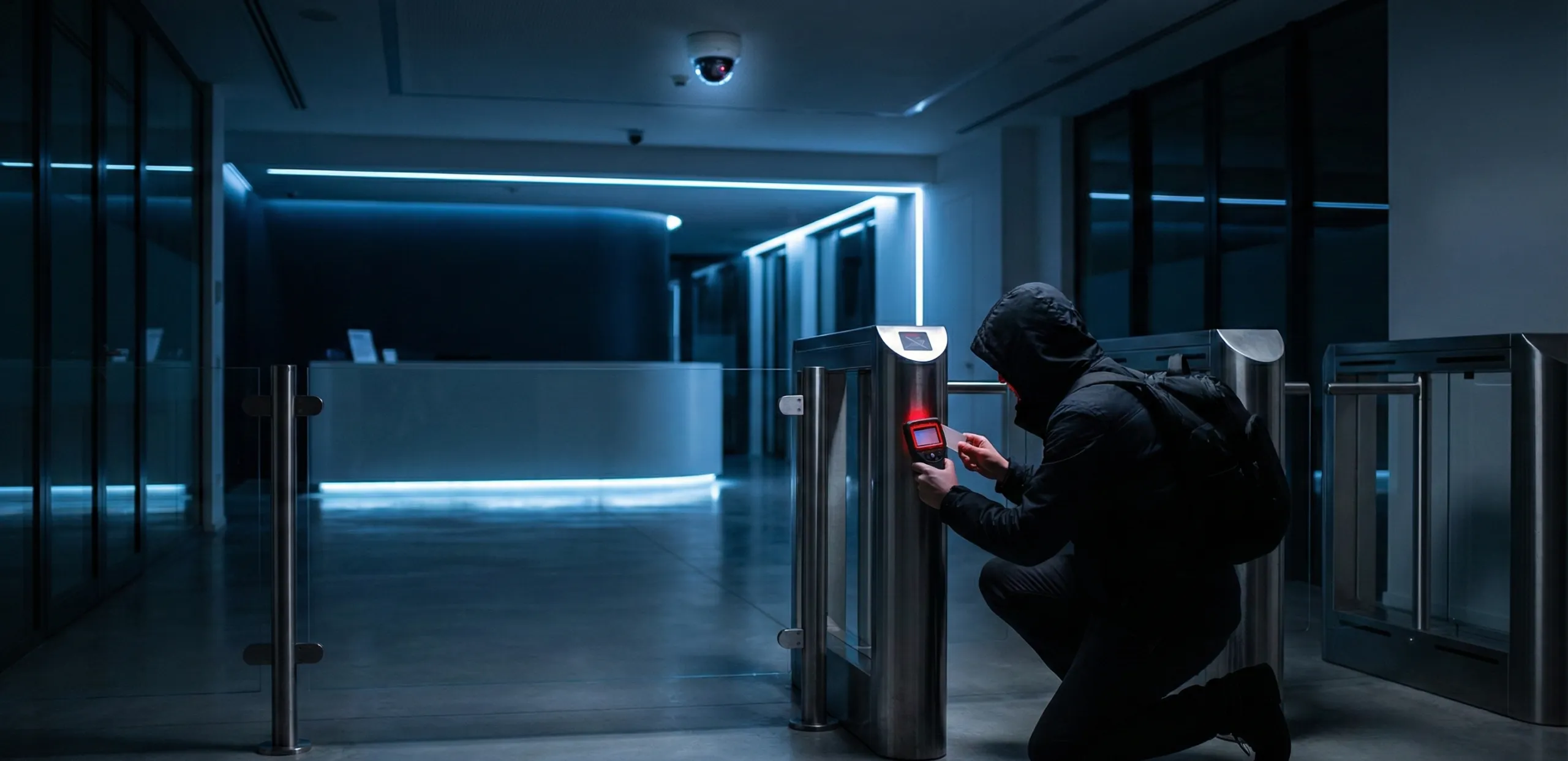
Many businesses protect their digital environment well, but physical operations remain dependent on routine. The reception, gatehouse, access cards, visitor arrangements and the movement of externs are places where security can only be verified by a controlled test.
A physical penetration test is an authorized check to see if an unauthorized person can go where they are not supposed to. It's not about catching people or fancy stories. The idea is to find weaknesses in process, training and control before a real attacker exploits them.
1. What a physical penetration test verifies
The test focuses on the practical operation of the mode. A paper guideline may be fine, but at the reception the visitor is let in unaccompanied, the staff hold the door for an unknown person or the incident is not reported anywhere. It is the difference between documentation and reality that is the main reason why physical testing is done.
Typically, entrances, visitor records, security work, escorting outsiders, marking of non-public areas, employee reaction to a suspicious situation, incident reporting and the ability of managers to evaluate what happened are evaluated.
2. Authorisation and rules of engagement
A physical penetration test must have clear terms of reference and written approval. Without it, it is not a security service, but an unauthorized act. The scope, time window, prohibited activities, contact person for ending the test and rules for the protection of personal data are determined in advance.
A well-set test also has safety brakes. If there is a risk of injury, damage, panic or interference with sensitive rights, the test will be terminated or interrupted. The goal is not to pass at all costs, but to get a reliable picture of where the regime works and where it fails.
| Area | What is being verified | Why it's important |
|---|---|---|
| Reception and gatehouse | Visitor identification, host contact, escort rules. | The first line often decides whether a stranger gets on. |
| Non-public zones | Readability of borders, access rights, reaction to an unknown person. | Weak zone control breaks down the entire security arrangements. |
| Staff | Willingness to verify permissions and report suspicious situation. | Technology doesn't help if people don't know what to do. |
| Reporting | Where the information is passed and how quickly it reaches the responsible person. | Without reporting, the incident becomes just a short episode with no lessons learned. |
3. Social engineering in a secure framework
The test may also include verifying how people react to pressure, authority, haste, or a seemingly normal operational situation. These principles should not be used to humiliate employees. They are meant to show where the rules are unclear or where people are not supported to politely decline an unusual request.
From a business perspective, it's important to set a culture where authentication is normal. An employee should not feel it is rude to ask for identification, call a host, or refuse passage to a non-public area.
4. Scope and safety limits of the test
The test specification specifies the objectives, scope, agreed boundaries and method of reporting findings. The output should be usable for the management, facility team and responsible persons who have to correct the weak points.
It is important to work with the objectives, rules and contribution of the test. A well-conducted test will show where the process is failing, what impact the weakness has, and what changes make sense for normal operations.
5. Test output
The value of the test lies in its findings, rather than in gaining access alone. The report should clearly describe the findings, evidence, risk impact, recommendations and priorities. A useful report identifies process and training gaps without blaming individuals unfairly.
The output should be usable for management, facilities, HR, IT, security and operations. Each of these roles needs to know what concerns them and what to change.
6. Correction and Repetition
The test should be followed by a remediation plan. It may include modifying the visiting regime, better marking non-public areas, training the reception, clearer rules for contractors, changing reporting or controlling access permissions.
A one-time test will help detect the condition at a particular moment. Real resistance only arises through repetition, evaluation and the fact that the findings are reflected in normal operation.
7. Why deal with it
Physical security is part of overall risk management. For some organisations it also relates to cybersecurity, personal data protection, business continuity or supply-chain security requirements. Even outside regulated sectors, a test can reveal the difference between the company’s expected procedures and what actually happens at its entrances.
Conclusion
A physical penetration test shows if the security mode works outside of paper. It should be authorized, reasonable, safely managed and concluded with a specific remedial plan. A well-executed test does not reinforce fear in the company. It reinforces a culture in which people are not afraid to verify permissions, report unusual situations, and stick to the rules even under pressure.